Linked

Louis H. Kauffman


Louis H. Kauffman
Department of Mathematics, Statistics, and Computer Science
University of Illinois at Chicago
Chicago, IL 60607-7045
Phone: (312)-996-3066
E-Mail: kauffman AT uic.edu
.

Research

I am a topologist working in knot theory and its relationships with statistical mechanics, quantum theory, algebra, combinatorics and foundations. This material is based upon work supported by the National Science Foundation under Grant No. DMS - 0245588 and by a grant to study quantum computation and information theory under the auspices of the Defense Advanced Research Projects Agency (DARPA).

See Wikipedia Information.

I am teaching Math 215 - Introduction to Advanced Mathematics - in Fall 2009. See Proofs!

I am teaching Mathematics 300, a course on writing mathematics. See Write Math!.

See also the Box Algebra Exercise. This is an exercise in the writing course and it is an introduction to the mathematics of G. Spencer-Brown and Charles Sanders Peirce.

COMBINATORIAL KNOT THEORY in Trieste in May 2009. (History: From September 1, 2003 to August 31, 2004 at the University of Waterloo and the Perimeter Institute in Waterloo, Canada. In July 2004, a workshop on knots and applications at the MSRI workshop at University of British Columbia in Vancouver, BC. Knot Theory in Trieste at the Abdus Salam International Centre for Theoretical Physics in May 2007. Jyvaskyla, Finland in August 2007. This link also applies to Math 569 for Spring 2007 and Math 568 for Spring 2009) See Knot Theory.

I taught Applied Linear Algebra, Math 310 in Spring 2008. See Vector Algebra.

I taught Calculus, Math 180 in Spring 2007. See Calculus.

I also taught a course in knot theory and topological visualization. For some notes about knots in the the seven color map on the torus see the pdf file The Knot in the Seven Color Map.

Here is a collection of internal and external links.
  • ArxivPapers LK papers on the Arxiv.
  • A selection of LK's papers. Papers
  • LOF Book in progress related to Laws of Form.
  • Non-Duality Slide show from Conference on Science and Non-Duality, San Rafael, CA, October 2009.
  • BOOLEAN NOTES Notes by LK on Boolean Algebra and Multiple Valued Logic, circa 1979.
  • KELLEY Excerpt on basic mathematics from book by John Kelley, part of the telvision course "Continental Classroon" that Kelley gave in 1960.
  • SIGN Sign and Space -- A Mathematical Essay.
  • SELFREF Self Reference and Recursive Forms.
  • LUHMANN Talk dedicated to Nicolas Luhmann by Heinz von Foerster, Translated by LHK and DBS.
  • REL Special Relativity and a Calculus of Distinctions.
  • ARITH Arithmetic in the Form.
  • COMPLEX Complex Numbers and Algebraic Logic, Proceedings of the Tenth International Conference on Multiple Valued Logic(1980), IEEE Computer Society Press, 209-213.
  • CalculusForSelfReference Paper on Self-Reference by Francisco Varela (FV).
  • NetworkSynthesisLK paper - Using Re-entry Calculus from Laws of Form for circuit design and self-reference.
  • DeMorgan Algebras LK paper on completeness, wave-form interpretation and recursion in DeMorgan algebras (four-valued logic), Proceedings of the eighth international symposium on Multiple-valued logic (1978).
  • Form Dynamics LK and FV paper - Spatial and Temporal Dynamics of Forms.
  • Imaginary Values LK paper - Imaginary Values in Mathematical Logic,Proceedings of the Seventeenth International Conference on Multiple Valued Logic, May 26-28 (1987).
  • ROBBINS LK paper on the Robbins problem from Proceedings of 20th Intenational Symposium on Multiple Valued Logic (1990).
  • Simplified solution to the Robbins Problem using Box Algebra RobbinsSolution
  • KNOT AUTOMATA LK Paper on knot automata and problems about asychronous circuit design from Proceedings of 24th Intenational Symposium on Multiple Valued Logic (1994)..
  • EigenForm Slides for a talk given in Vienna in November 2006 -- the "Heinz von Foerster Lecture on Cybernetics".
  • EigenForm LK paper on Eigenform.
  • Peirce LK paper on the Mathematics of Charles Sanders Peirce.
  • TimeParadox LK paper on time, paradox, multiple-valued logic.
  • VirtualLogic LK Kybernetes paper on Virtual Logic.
  • Bios Paper on Bios with Hector Sabelli.
  • MathematicalBios A second paper on Bios with Hector Sabelli.
  • "KnotLogic" Paper by LK on foundations of mathematics and logic in relation to knots. Discusses knot set theory, lambda calculus, magmas, braids, tangles, electricity, pregeometry and more.
  • Quaternionic Fractals Hypercomplex
  • A selection of Yumei Dang's Hypercomplex Fractal images. Yumei
  • Quantum Topology and Quantum Computing Slides for a talk given at Stony Brook in November 2006 -- The Simons Lectures and at the Wollic Conference in Rio de Janeiro in July 2007.
  • TQIT Survey paper on Topological Quantum Information Thoery, including discussion of topological and quantum entanglement, unitary solutions to the Yang-Baxter equation, spin-networks and the Fibonacci model and generalizations producing universal topological quantum computing, quantum algorithms for the colored Jones polynonmials and more.
  • "SpaceTime Structure in High Energy Interactions" pdf scan of a pioneering paper by David Finkelstein (Coral Gables Conference - University of Miami (1969)) that contains the earliest definition of a quantum computer that I have found.
  • Iconic Slides for a talk given in Brussels, December 2008 at Trends in Logic VI and for the talk I gave at the Short Course in Quantum Compputing at the AMS Meeting in Washington D.C. on January 4, 2009. Shows how the Fibonacci model, universal for topological quantum computation is constructed from the "logical particle" implicit in C. S. Peirce's Sign of Illation and in the Mark of G. Spencer-Brown, and the relationship of this logical particle to the Jones polynomial and the Temperley-Lieb recoupling theory. This structure leads to quantum algorithms for computing colored Jones polynomials and Witten-Reshetikhin-Turavev invariatns at roots of unity.
  • BioLogic -- What is the relationship of Logic and Biology? Slides for a talk given at the Wollic Conference in Rio de Janeiro in July 2007.
  • NonCommutative Worlds Slides for a talk given at the Newton Institute in Cambridge, UK in December 2006 -- Conference on NonCommutative Geometry. See Newton Institute.
  • NonCommutative Worlds The LK Paper.
  • Discrete Non-Commutative ElectromagnetismPaper by LK and Pierre Noyes giving a discrete interpretation to the Feynman-Dyson derivation of electromagnetism from a commutator calculus.
  • Knots, Braids and Elementary Particles Slides for a talk given at the Red Raider Conference in Lubbock, Texas, October 2008.
  • KNOT PRODUCTS 1 Short paper by LK on a product construction of knots in all dimensions that constructs exotic differentiable structures, Brieskorn manifolds and knot periodicity of the knot cobordism groups in high dimensions.
  • KNOT PRODUCTS 2 Paper by LK and Walter Neumann about knot products and links of singularities.
  • TWIST SPINNINGPaper by LK on a generalization of the twist spinning fibration theorem of Christopher Zeeman, using the knot product construction.
  • "Link Manifolds" Paper by LK on differentiable classification of high dimensional manifolds with O(n) actions and orbit spaces the four-ball, fixed point set corresponding to a link in the three-sphere. Example given of a link where the reversal of an orientation of one component corresponds to the addition of an exotic sphere to the O(n) manifold.
  • "Exotic"Article by LK giving an introduction to characteristic classes, cobordism, Hirzebruch Index Theorem and the existence and construction of spheres with exotic differentiable structures.
  • KNOTS A short course in knot theory from Reidemeister moves to state summations to Vassiliev Invariants and quantum fields.
  • "Conway's ZIP Proof" pdf file of paper by George Francis and Jeff Weeks, giving John Horton Conway's proof of the classification of surfaces using zippers in place of the quotient topology!
  • "Topological Invariants of Knots and Links" pdf file of J. W. Alexander's paper (1928).
  • "A Quick Trip Through Knot Theory" pdf file of the classic paper on knot theory by Ralph Fox (1961). This paper has been a key introduction to knot theory for generations of knot theorists!
  • "FoxCalculus" LK notes on Fox Calculus, Seifert Pairing and Alexander Polynomial.
  • "New Invariants in the Theory of Knots" pdf file of paper by LK in the American Mathematical Monthly (1987).
  • "ReformulatingMapColoring" pdf file of paper by LK about formulations of map coloring problems.
  • "Impasse Group" Paper by Irving Kittell (BAMS 1935) articulating a group of recoloring operations on a map that is all colored except for a five-sided region.
  • "Tutte Polynomial Signed Graphs" pdf file of paper by LK about a Tutte polynomial for signed graphs that extends the classical Tutte polynomial and includes the bracket polynomial for knots and links as a special case.
  • "Whitney's Theorem on Map Coloing" fundamental paper by Hassler Whitney.
  • "Snarks" a copy of the seminal paper by Rufus Isaacs constructing uncolorable, non-planar cubic graphs.
  • "Petersen"A paper on the Petersen Perfect Matching Theorem.
  • "Tutte"A paper by Tutte on the Four Color Theorem.
  • "Frictional Analysis of Hitches" pdf file excerpt from my book "Knots and Physics" showing how to analyze the strength of a hitch. Useful for those who climb mountains, dock boats or ride horses.
  • NOTES A FULL course in knot theory from Reidemeister moves to state summations to Vassiliev Invariants and quantum fields. These notes are a preliminary draft of a book based on a course given in fall 1997 at Institute Henri Poincare in Paris, and a continuation of that course in the winter of 1998 at UIC.
  • Knot Tables Rolfsen's Knot Tables Rendered by Dror Bar-Natan.
  • Website of Sofia Lambropoulou. Tangles
  • Website of Sam Lomonaco. Quantum Computation
  • Website of Morwen ThisthlethwaiteJones Links
  • Cybernetic Math Cyber{K}nots
  • Cybernetic NumbersWhat is a Number?
  • Fourier Knots Fourier Trefoil and The Pattern
  • DoubleHelix Trefoil DoubleHelix
  • Thoughts on the Pattern Mereon Pattern
  • Mereon Institute Mereon
  • World Scientific WS
  • The Journal of Knot Theory and Its Ramifications JKTR
  • The Book Series on Knots and Everything K&E
  • The Geometry Center Graphics Archive Images
  • The Projects of Robert W. GrayBob Gray
  • Foxy Knots Rob Scharein
  • Celtic Knot Design. Celtic Knots.
  • Silliness. Goose

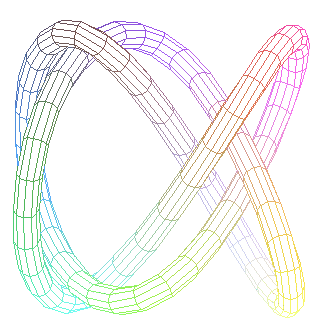
    Lissajous Knot

    (2,3,5) Lissajous

    Just for a beginning, before the knots begin to appear. Let's consider:
    What is a knot? If it is in the plane, then it is not. If it is not then it is a knot.
    Along with knots and nots, I am fascinated by PARADOX.
    Let G be defined by the equation
    Gx = F(xx).
    Then
    GG=F(GG).
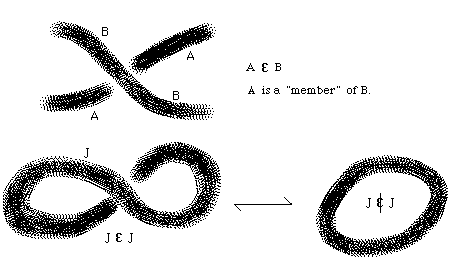
    Thus, if J=GG then J=F(J) for any F! (This is the fixed point theorem of Church and Curry in the untyped lambda calculus). The fixed point theorem gets you very quickly to paradox. For example, let AB mean "A is a member of B". Let Rx = not(xx). (That is, x is a member of R only if x is not a member of x.) Then RR = not(RR). R is a member of R only if it is not a member of R! R's Self-Membership is in a state of doubt.
    Now imagine a simple loop of rope. Allow that when a bit of line passes underneath another bit of line, we shall say that the underpassing bit "belongs" to the overpassing bit. Membership by underpassage.
    The simple loop is then an empty "knot set". Put a twist in the loop and it underpasses itself. The singly twisted loop is a member of itself. Loop and twisted loop are topologically equivalent. Hence, speaking {topo}logically, the simple loop is both a member of itself and not a member of itself. By this simple twist of logic, the paradox becomes a phenomenon of three dimensional space.

    Untwisting Russell's Paradox

    Paradox is not all there is to knots. The problem of finding invariants of knots has led to extraordinary connections of knot theory with many different fields. In the next few paragraphs, I will comment on some of these connections.

    Knots and State Summations

    Here is a brief introduction to the subject of knots and statistical mechanics. The motivating idea is that a physical system has many different configurations that it assumes over time. These are the "states" of the system. Significant physical quantities are obtained by averaging over all the states of the system. By analogy, a topological space may have a natural collection of states associated with it. Significant topological quantities may be obtained by averaging over the states of the topological space!
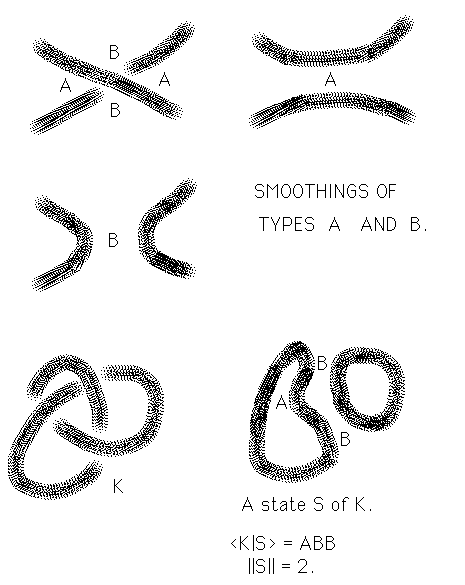
    We shall describe the state summation model for the bracket polynomial and its relation to the original Jones polynomial. Given a diagram for a knot, it is possible to reduce it to a collection of Jordan curves in the plane by "smoothing" each crossing in one of the two possible ways shown in the diagram below.

    A "state" S of a link diagram is a choice of smoothing for each of its crossings.
    It is of historical interest to realize that the idea of smoothing crossings in a knot diagram was used by the designers of Celtic knots. Starting from a highly regular diagram, the designer smooths collections of crossings to obtain the desired design. To see a demonstration of this, try the following link for celtic knot design.
    We encode the type of smoothing by labelling it "A" or "B" according as the regions that are joined are labelled A or B. This labelling is illustrated above. The four local regions incident at a crossing are labelled A and B with the two A's occupying vertical angles as are the two B's. In this labelling, the two A regions are swept out when the overcrossing line is swept counterclockwise. (This convention pinpoints the assignment of A's and B's.) Thus a state is decorated with the labels at the sites of its smoothings. We call these labels the "vertex weights" of the state. If K is a link diagram and S is a state of that diagram, let [K|S] denote the product of all of the vertex weights (labels A or B) for that state. Note that [K|S] depends upon the structure of over and under crossings in the link. Let d be a third algebraic variable commuting with A and B (A and B commute with each other). Let ||S|| denote the number of Jordan curves in the state S. The Bracket Polynomial is defined to be the summation
    [K] = SUM Over States S {[K|S]d^||S||}.
    By adjusting the variables A,B and d correctly, the bracket polynomial [K] reads out deep topological information about the link K.
    The correct adjustment turns out to be B=1/A and d=-A^2 -A^(-2) where X^Y denotes X raised to the Yth power. With this adjustment the bracket polynomial is invariant under the basically flat Reidemeister II and III moves and multiplies by -A^3 or -A^(-3) under a type I Reidemeister move. What is a Reidemeister move? In the next incarnation of this page, there will be a hyperlink to a discussion of the Reidemeister moves. They are a simple set of basic moves on link diagrams that generate topological equivalence. The unnormalized bracket polynomial is an invariant of what is called "regular isotopy."
    We normalize the bracket polynomial to create a full invariant of ambient isotopy for knots and links, denoted by f[K](A) with the formula
    f[K](A) = (-A^3)^(-w(K)) [K]
    where w(K) is the sum of the signs of the crossings of the oriented diagram K. The sign of a crossing is plus one if a counterclockwise rotation of the overcrossing line puts it in parallel orientation to the undercrossing line.
    The Jones polynomial (discovered by Vaughan Jones in 1984) can be expressed in terms of the bracket polynomial. The Jones polynomial is modelled by the bracket through the formula
    V[K](t) = f[K](t^(-1/4)).
    It is an open problem whether the Jones polynomial detects knots! That is we can conjecture that V[K](t) =1 implies that K is unknotted for a knot diagram K. So far there is no counterexample to this conjecture.
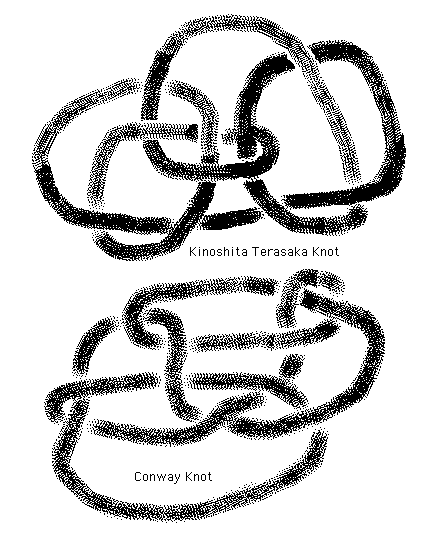
    On the other hand, there are many pairs of knots K, K' such that K and K' have the same Jones polynomial, but K and K' are topologically distinct. One such pair is shown below. They are KT, the Kinoshita-Terasaka knot, and C the Conway knot. C and KT are MUTANTS of one another; each can be obtained from the other by removing a box with four strands (a "2-tangle") and replacing the box after turning it around by 180 degrees. The KT and the C are both 11 crossing knots, with non-trivial Jones polynomial. They can be distinguished from one another by subtler means. It is also noteworthy that KT and C are the smallest knots with Alexander polynomial equal to one. There are many knots undetectable by the Alexander polynomial, and no classification of them is known.
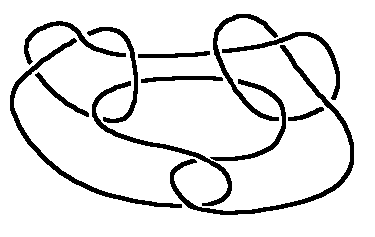
    Below the picture of KT and C, you will see a twelve crossing diagram of KT. Contemplation of this picture reveals that KT is a ribbon knot, a special form of knot that is "slice" ( i.e. it bounds a smooth disk in the four dimensional ball). A ribbon knot bounds a disk immersed in the three sphere with so-called "ribbon singularities". In a ribbon singularity two arcs from the disk cross transversely. One arc is in the interior of the disk. One arc has its boundary points in the boundary of the disk. It is unknown whether every slice knot is ribbon.

    Twelve Crossing Version of KT